Turo Check-In and Checkout: Building a Process That Holds Up in a Claim
What to capture at pickup and return, in what order, and why the return record is the one that decides disputes.
 By The FleetSnap Team·6 min readUpdated

In this guide
Most check-in and checkout advice is about photographs. Take lots of photos, it says, and keep them somewhere.
That advice loses disputes. Not because photos are useless, but because a pile of photos is not a record, and the difference between the two is what decides whether you get paid when a car comes back damaged.
Here is the version built around what actually survives a disagreement six weeks later.
The deadline that shapes everything
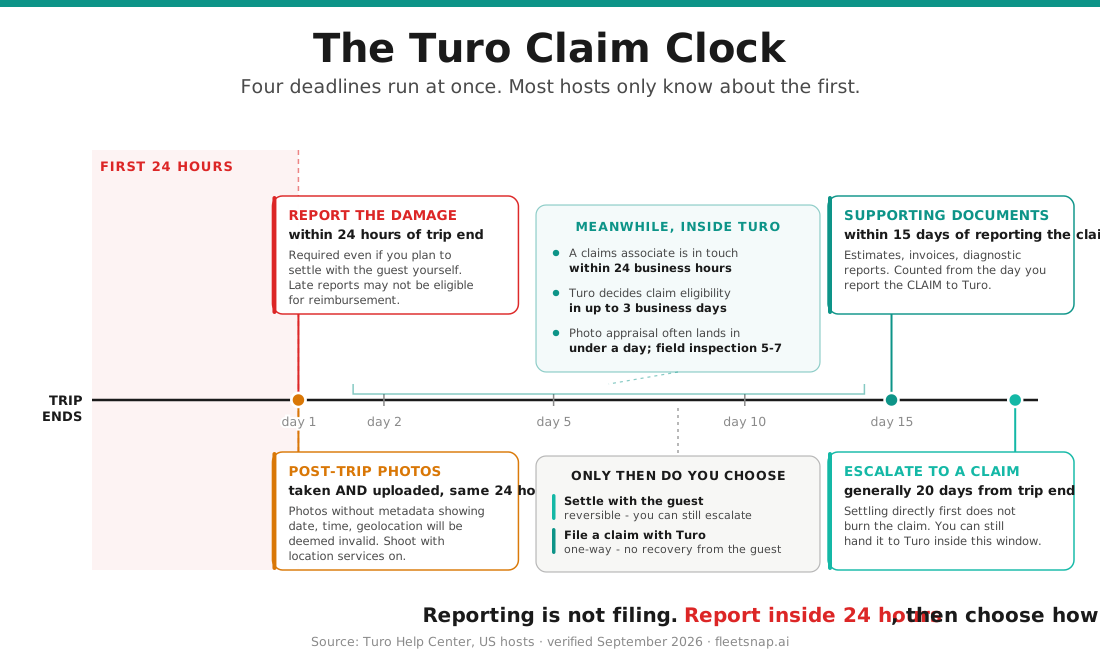
Before any of the process: on Turo you must report damage no more than 24 hours after the trip ends to start the resolution process. Checked against Turo's help center on 12 October 2026, and laid out with the other claim deadlines in the Turo claim clock.
One day. That single constraint determines the whole design of your checkout routine, because a process that depends on you getting around to inspecting the car properly on Thursday for a trip that ended Tuesday is not a process, it is a hope.
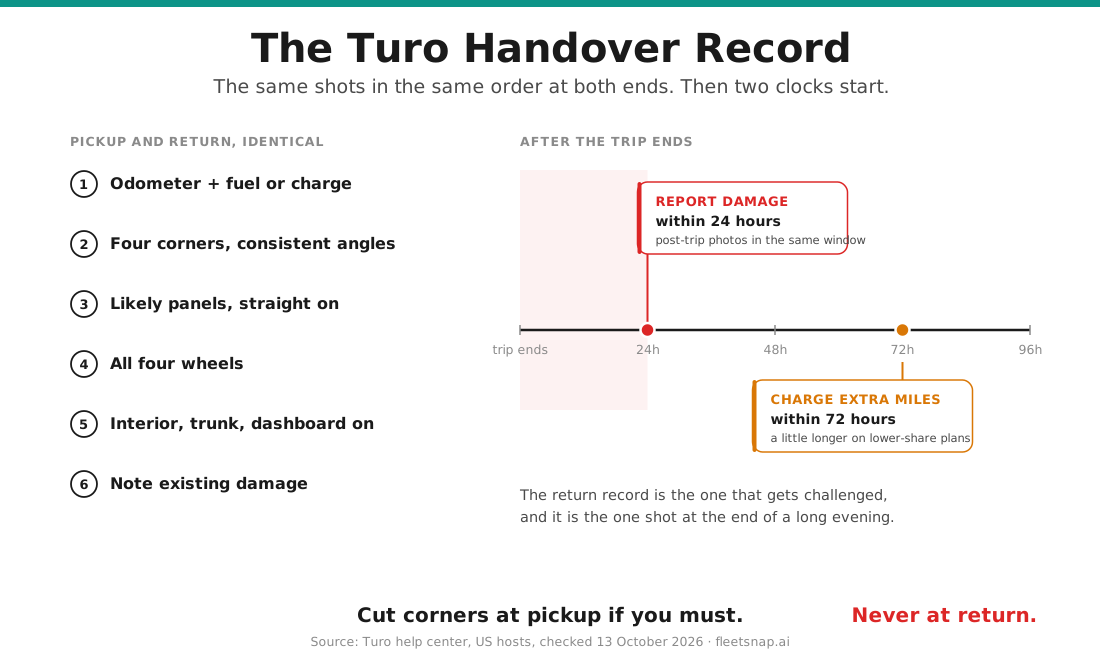
There is a second and looser deadline worth knowing alongside it. Turo gives you 72 hours from the trip ending to charge for additional distance, a little longer on the lower-share earnings plans. So a car that comes back both damaged and over its mileage has two clocks running at different speeds, and the tighter one is the expensive one.
What a record needs that a photo album does not
Four things. Most operators have two or three.
Consistent coverage. The same angles every time. Every panel, all four wheels, the interior, the odometer, the fuel or charge level. Consistency beats thoroughness, because a dispute is settled by comparing like with like. Twelve standardized photos are worth more than forty random ones.
Timing that can be established. Not the file's date, which is editable, and not the device clock. The capture time needs to come from a system rather than from the image. Turo also deems photos without date, time and location metadata invalid, so shoot with location services on.
Association to a specific trip and vehicle. Photos in a shared album prove a car existed. The record needs to say this vehicle, this trip, this guest, this moment.
Retrievability in under two minutes. If finding it takes an evening, the record effectively does not exist, because at volume you will stop looking and then stop filing.
The pickup sequence
Three minutes, in a fixed order so nobody has to decide what comes next.
- Odometer and fuel or charge. Together, in one frame if possible. This is the billing evidence.
- Exterior, four corners. Each at a consistent angle, capturing two panels per shot.
- Each panel straight on where damage is most likely: doors, bumpers, hood.
- All four wheels individually. Curb damage is the most commonly disputed item and the most commonly missed.
- Interior. Front, rear, trunk, and the dashboard with the car on.
- Note existing damage explicitly rather than hoping the photos imply it.
Guests often photograph the car at the same handovers. That is not a reason to skip your own set. Your job is to capture a consistent record at the same moments, so you have something to compare theirs against.
The return sequence
Identical. Not similar, identical.
The same angles in the same order, because a dispute is resolved by comparing the same view before and after. A photo of the front before and the rear after proves nothing about the panel in question.
Two things that go wrong at return specifically.
It gets rushed. Pickup happens when you are organized and the day is ahead of you. Return happens at the end of a long evening with somewhere else to be. So the capture quality is worst exactly where it matters most, because the return record is the one that gets challenged.
It gets deferred. The car comes back late, you will look at it properly tomorrow, and tomorrow is already outside a 24 hour window that started when the trip ended.
If you are going to cut corners somewhere, cut them at pickup. Never at return.
When you find damage
Flag it immediately, while the guest is still present or still reachable. A difference raised at return is a conversation. The same difference raised three days later is an accusation, and it will be met accordingly.
Report inside 24 hours. Not when you have a quote, not when you have decided what to do. Start the process, then gather the rest.
Get a real estimate. A repair quote from a shop carries weight. A figure you arrived at yourself does not.
Check it clears the threshold. Turo does not reimburse exterior wear and tear, defined as dings, dents, cracks or scratches to the exterior body that are 3 inches in diameter or less. Below that line it is yours regardless of how good your evidence is, which is useful to know before you spend an hour on a claim.
Record the downtime. Days the vehicle cannot earn are a real cost. Turo's US earnings plans don't include loss of hosting income, but you need the number for your own per-vehicle profit picture.
Do not put the car back out before filing. A vehicle that has been on another trip since the damage is a much weaker claim.
Making it survive a busy week
The constraint that decides whether any of this happens is time per handover.
A ten minute routine gets skipped on the days you most need it, which are the busy ones. Three minutes is roughly the ceiling for something done consistently at volume.
What makes it fast: a fixed sequence so nobody is deciding, prompts rather than free capture, a standard set rather than a judgment call, and no typing beyond the odometer.
What makes it slow: free-form photography, written condition notes, and anything requiring the person holding the phone to work out what matters.
Below about ten vehicles a disciplined phone routine with a written shot list genuinely works. Above that, retrieval and consistency break down and operators quietly start absorbing damage rather than claiming it. That transition is rarely a decision. It is a drift.
Where FleetSnap fits
Damage is documented against the specific vehicle and trip rather than sitting in a general album, and claims are tracked through to recovery with the open ones visible rather than depending on memory. That tracking is the part that matters most, because the majority of unrecovered damage is lost to claims never filed or never followed up rather than to claims refused.
The guest conversation sits alongside it. The AI reads and ranks every incoming message so a guest mentioning a scrape surfaces rather than getting buried under parking questions, with your team still writing every reply.
Check-in and checkout capture is live. Your field team works from the operator portal, where every handover photo is kept with the data showing when and where it was taken.
What to look for in any capture tool, FleetSnap's or otherwise, is in the vehicle damage inspection app guide.
Questions hosts ask
How long do I have to report damage on Turo?
No more than 24 hours after the trip ends to start the resolution process. Additional distance charges are a separate and longer window of 72 hours, a little longer on the lower-share plans.
What should I photograph at Turo pickup and return?
The odometer and fuel or charge level, all four corners of the exterior, each likely-damage panel straight on, all four wheels individually, and the interior including the dashboard. The same set in the same order at both ends.
Why do damage claims get denied?
Usually no pre-trip baseline, before and after images that do not show the same thing, timing that cannot be established, or a claim filed outside the window. All four are documentation problems rather than fairness problems.
Are phone photos enough?
Under about ten vehicles with a fixed shot list, usually. Above that, retrieval and consistency break down and most operators start quietly absorbing damage instead of claiming it.